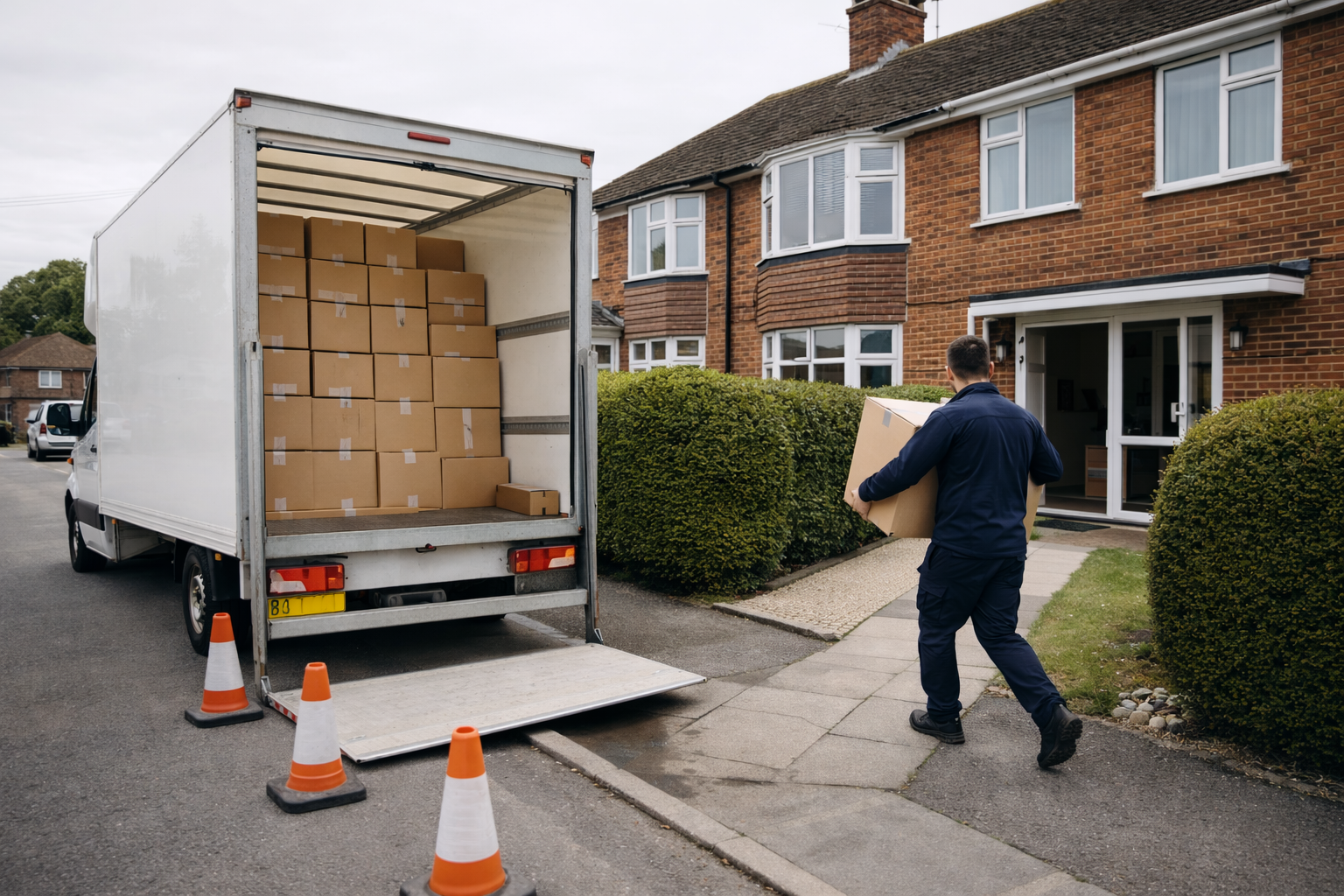
You've packed everything, booked a removal company, and you're ready to go. But have you thought about where the removal van will park? Or whether your furniture can actually get out of the building? Parking and property access are among the most common causes of moving day delays — and they're entirely avoidable with a bit of preparation.
Why Access and Parking Matter
A standard removal lorry is 7.5 metres long and 2.5 metres wide. A Luton van is around 6 metres long. These vehicles need:
- A parking space close to your front door — ideally within 10–15 metres. Every extra metre adds time to the move.
- Enough height clearance — watch out for low bridges, car park barriers, and overhanging trees.
- A firm, level surface — soft ground, gravel, and steep drives can be problematic for heavy loads.
When movers can't park close, they face long carries. This slows the move, increases the risk of dropping items, and can add significant time (and cost) to your move.
Checking Your Parking Situation
At Your Current Property
Ask yourself these questions:
- Is there a driveway? If so, will the removal van fit? Measure the width and check for any height restrictions (gates, overhanging branches).
- Is it on-street parking only? If so, is it a residents' parking zone? You may need a parking suspension from your local council.
- Are there double yellow lines? You'll need a temporary parking dispensation.
- Is it a busy road? Consider timing — early morning before traffic builds is usually best.
- Is there a loading bay nearby? For flats and commercial properties, check if there's a designated loading area.
At Your New Property
The same questions apply, plus:
- Have you visited the new property to check access? Don't assume — check in person.
- Are there any access codes or keys needed? For gated communities, apartment blocks, or shared driveways.
- Is there a lift? If you're moving into a flat above ground floor, check the lift dimensions. Can your sofa fit?
- Are there any move-in restrictions? Some apartment buildings restrict moving to certain days or hours.
How to Arrange Parking Suspensions
If you need to reserve a parking space on a public road, you'll need to contact your local council. Here's how:
- Apply online through your council's parking or highways department.
- Apply early — most councils need 5–10 working days' notice. Some need longer.
- Specify the dates and times you need the space reserved.
- Pay the fee — typically £25–£65 depending on the council and duration.
- Put up cones and signs — the council will usually provide "no parking" signs. Place them at least 24 hours before your move.
Common council parking suspension costs:
| Council | Approximate Cost | Notice Required |
|---|---|---|
| Southampton | £30 – £50 | 5 working days |
| London boroughs | £40 – £65 | 5–10 working days |
| Manchester | £35 – £55 | 5 working days |
| Birmingham | £25 – £45 | 5 working days |
Property Access: Front and Back Entrances
When you request a quote from a removal company, they need to know about your property's access points. Here's what to tell them:
Front Access
- Standard front door: Most houses have a front door that opens onto a path or pavement. This is the simplest scenario.
- Shared entrance or communal hallway: Common in flats. Check the width of corridors and any fire doors that might restrict large items.
- Steps up to the door: How many? Are they steep? Steps slow things down and make heavy items harder to handle.
- Narrow pathway: Some terraced houses have a narrow path from the pavement to the front door. Measure this — if your sofa is wider than the path, you'll need an alternative route.
Rear Access
- Garden gate or side alley: Some properties have a back entrance that's actually easier for moving large items. If your front door faces a busy road but there's a quiet rear access with more space, mention this to your movers.
- Patio doors or French doors: These are often wider than front doors and can be a great alternative route for large furniture.
- Garage access: If you have a garage that connects to the house, this can be another entry point.
Things That Cause Access Problems
- Spiral staircases — large furniture can't navigate tight spirals. You may need a furniture hoist.
- Narrow Victorian hallways — older properties often have hallways under 900mm wide.
- Low ceilings — especially in basements and loft conversions.
- Basement flats with external steps — steep, narrow steps to a below-ground entrance.
- Listed buildings — restrictions on what can be done to doors and openings.
What to Tell Your Removal Company
When requesting a quote, provide these details to avoid surprises:
- Parking availability — driveway, on-street, permit zone, or loading bay?
- Distance from parking to front door — rough estimate in metres.
- Floor level — ground floor, first floor, or higher? Is there a working lift?
- Number of stairs — flights and approximate number of steps.
- Access restrictions — narrow paths, tight turns, low ceilings, communal areas.
- Best entry point — front door, back door, patio doors, or side entrance.
- Time restrictions — any rules about when deliveries or moves can happen (e.g., apartment block rules).
Being upfront about access saves time and money. If movers arrive to find your street is a narrow cul-de-sac with no nearby parking, the move takes longer and costs more.
Tips for Smooth Access on Moving Day
- Clear the path. Move bikes, bins, plant pots, and anything else blocking the route from the van to your door.
- Prop doors open. Use doorstops on all doors along the route. Close doors to rooms you're not using.
- Protect floors and walls. Lay down protective sheeting in hallways and on stairs. Our team brings floor protectors as standard.
- Communicate with neighbours. If you share a driveway or narrow street, let neighbours know so they don't block access.
- Keep children and pets away from the moving route for safety.
- Have someone at each property. If you're moving between two addresses, have a trusted person at each end to manage access.
How Tanoli Moving Handles Access
When you get a quote from us, we ask about parking and access upfront. Our team:
- Assesses access during the quoting process so there are no surprises.
- Arranges parking if needed — we can advise on council suspensions and assist with applications.
- Brings appropriate equipment — trolleys, ramps, furniture sliders, and protective materials.
- Plans the best route through your property for large items.
- Offers Luton van hire when a full-sized lorry can't access your street — our Luton van fits in tighter spaces.
Tell us about your property access when you request a quote and we'll plan accordingly. No hidden charges, no moving day surprises.